80% of people who use archives are family historians

There’s a drive in the US to make October “family history month“, and tweets from this week’s OCLC special meeting “Moving the Past into the Future: Special Collections in a Digital Age” declared…

80% of people who use archives are family historians – the genealogists

So, it is just as well RunCoCo is speaking to the Federation of Family History Societies this weekend, at their Education Seminar in Northampton.

ffhs-link

The agenda:

  • Education, Education, Education – This session will introduce a couple of specific points for discussion and then you will get the chance to tell us, and discuss, what you think the Federation should be doing, or helping you to do, to further our common educational aims.
  • The Great War Archive – Alun Edwards of Oxford University Computing Services will introduce you to the The Great War Archive, a community collection project. You can view the results of this project for yourselves alongside a collection of WWI Poetry. The focus of this talk will not be on the results. Rather, it will focus on the methodology and bespoke software behind the project. This session will have something for webmasters, for project coordinators and anyone with thoughts of running a community collection project.
  • 21st Century Archives and the Family Historian – This presentation will be made jointly by the Northamptonshire County Archivist, Sarah Bridges, and her deputy and Public Services Manager, Daniel Williams. Archives are under pressure, what can family historians expect? – and what will family historians get?
  • Being a Treasurer (of an FHS) – Mr Griffiths from Dove Naigh Group, who prepares the accounts for Northamptonshire FHS, will be appraising us of the rules and regulations that treasurers of family history societies must abide by. This will be an essential background for new treasurers, an update on recent legislation for existing treasurers and useful background for the rest of your executive committee.

A link to RunCoCo’s presentation will be published soon.

Posted in events (external), project news | 1 Comment

Workshop speaker: Kate Lindsay

The RunCoCo project builds on the work done on the Great War Archive project. We are very pleased to be able to welcome the project manager for the Great War Archive project Kate Lindsay among the speakers at the RunCoCo event in Leeds on November 3rd.

The Great War Archive project was run as part of a larger research and digitisation project (First World War Poetry Digital Archive). In only a few months, and with limited staff and funding, the small project collected and catalogued over 6,500 items and made these available for the world to explore online.

The Great War Archive presented an innovative approach to collection strategies, digitisation, cataloguing, and public involvement in major research projects. It harnessed the power of the Web along with the potential of ‘mass’ amateur digitisation to collect thousands of items from World War One that would otherwise have disappeared or remained hidden from researchers and scholars worldwide. (Great War Archive website)

Kate will be talking about the Great War Archive project and in particular about their use of free web-based services such as Flickr. The Great War Archive ran its collection between 3 March and 30 June 2008. After that, people were invited to add any items they wanted to share to a Flickr group. Over 2,500 photos have been added so far, and the collection is still growing. People can also comment on the photos and take part in discussions, which is one community-led way of keeping the project going after the end of the funding.

Kate will also be around during the day, ready to answer questions and talk to participants and presenters about her work on the Great Was Archive and as Manager for Engagement and Discovery at Oxford University Computing Services.

About the workshop

The RunCoCo workshop on sustainability will take place in Leeds on November 3rd, 2010. You can learn more about the event on the RunCoCo workshop page.  To register for this free event, please complete the registration form.

We look forward to welcoming participants who are interested in community collections or working to harness a community to enrich an existing collection with tags or comments. This free event is open to participants from the education, public, and voluntary sectors, as well as private consultants. Places are limited and offered on a ‘first come’ basis. Registration will be open until all places are filled but no later than October 15.

Posted in events, project news | Comments Off on Workshop speaker: Kate Lindsay

Crime report

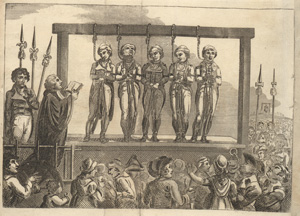
The execution of John Carpenter, alias Hell Fire Jack, the noted horse stealer, at Tyburn, 1805

The execution of John Carpenter, alias Hell Fire Jack, the noted horse stealer, at Tyburn, 1805

Last week Melissa Highton (RunCoCo’s director) attended the academic advisory group of the Mapping Crime project. (RunCoCo blogged about the previous meeting in May 2010.)

With this project the Bodleian Library is providing links between the crime material available through the John Johnson Collection: An Archive of printed Ephemera and other online resources containing related material or source information.

From this Academic Advisory Board meeting Melissa writes:

“It was an interesting meeting about a fascinating resource. I found the discussions about community engagement, adding value and discovery particularly interesting.

‘Discovery’ mostly concerned how this additional resource would be found within the larger John Johnson Collection. The project will create a handcrafted set of links between related resources and information to guide researchers to information directly related to their line of enquiry, and will allow them to build connections or follow trails between different resources. The fact that the collection project is called ‘mapping’, would lead some people, I think, to assume it included maps. ‘Mapping crime’ as in ‘the geography of crime’ usually does. I’m not sure if continuing to call the resource ‘mapping crime’, after the linking activity has been done will make sense to users coming to the resource for the first time.

We discussed briefly the role of the expert researcher/archivist in adding value to each of these collections by creating the links between them. At a time when linked data projects are focussing on automatic generation of links, the expert is expensive, but perhaps still essential in work like this? It reminded me of lessons learned from the creation of The Great War Archive.

With regard to communities perhaps not thought of by the project team it struck me that the project will create a cracking resource for the great Oxford tradition of crime writing and perhaps the Centre for Creative Writing at Kellogg College.

Looking for a report of a bizarre crime from Victorian times to trigger your inspiration? John Johnson‘s your man.”

Image credits:

  • The life and death of John Carpenter, alias Hell Fire Jack… (permanent URL) Copyright © 2008-2010 ProQuest LLC. All Rights Reserved. Images and metadata copyright © Bodleian Library, University of Oxford.
Posted in case studies, digitisation & ugc, project news | Comments Off on Crime report

Developing online resources course

GEM (Group for Education in Museums) is organising a training day on October 18 2010 on the theme Developing Online Resources.

Planning, evaluating, creating and testing online resources including for whiteboards. GEM website

The event is held at the Fleet Air Arm Museum in Ilchester, Somerset. Interested participants can contact the trainer in advance to have their online learning resource or website included in the user testing session.

More information about the event can be found on the GEM website.

Posted in events (external) | Comments Off on Developing online resources course

19th century children’s hospital records

The Historic Hospital Admission Registers Project (HHARP) is a useful example of how volunteers can help make material that would otherwise be hidden from most users widely available online. As further shown below, it is also a good case study for how to manage certain issues that will come up in digitisation and community contribution projects.

About the project
The HHARP database contains almost 120,000 records that have been transcribed from Victorian and Edwardian patient admission registers by a set of volunteers.  The records all relate to children and cover periods between February 1852 and  December 1914. The project, which started in 2001, now makes available material from four hospitals: the Hospital for Sick Children (Great Ormond Street), the Evelina Hospital (now part of Guy’s and St Thomas’s NHS Trust), the Alexandra Hospital for Children with Hip Disease, and the Royal Hospital for Sick Children in Glasgow.

a portal into the world of Victorian and Edwardian children’s hospitals (from the HHARP website)

The HHARP database is a useful resource for family historians but also for anyone interested in the period. The website offers access to the database but also articles about the hospitals  and ‘pen portraits’ and images of some of the people featuring in the database. Access is free and anyone can search the collection. Registered users get access to advanced search options and more detailed records and can download and print the records.

Method
Although the HHARP is not making use of an online community of volunteers for their transcription work, the project can serve as a useful example for other community collection projects. The project describes its methodology  in some detail on their webpage. Basically, their workflow has been:

  1. The original records were microfilmed and digital photocopies were made.
  2. Batches of the records were issued to volunteers.
  3. Volunteers transcribed the records exactly as they appeared. Standardised versions of the key data elements were added.
  4. A set of indexes was developed to facilitate searching.
  5. The database was expanded to allow entry of new data elements as additional hospitals, with slightly different records, were added to the project.

Some points that any project may benefit from considering include:

  • Comparison between data sets of different origin: Use the same methodology for each set of records to enable meaningful comparisons.
  • Keep track of the originals: Number and label each batch of data to be able to keep track of them and make sure all get done and unnecessary duplication is avoided.

Balance authenticity and standardisation
Historical records and material created by hand by a large number of different contributors (such as hospital admission records) will display a number of inconsistencies, errors, and variant spellings. That means that it can be difficult to cross-search the collection, as the same person, disease, place, etc can be written in different ways. One way to get around that is to standardise spellings – to decide that all instances of a particular word always be input in the same way. Doing that will facilitate cross-searching but at the loss of authenticity.  It may also require more user training, to make sure the transcribers choose the right version and users know what to search for.

Each project needs to decide what is the right approach for them but as the HHARP shows, it is possible to both have the cake and eat it. HHARP has chosen to preserve the authenticity of the records and transcribe any variants and errors as they occur in the original.  In addition to this, they added standardised versions of some elements. That means that it is possible to search the database and retrieve all relevant records, but without loosing the original variation.

Standardised versions of the key data elements enabled such original errors to be corrected while maintaining the integrity of the source material. (from the HHARP website)

A further way to facilitate searching of the data is to create indexes. HHARP have produced indexes for various elements, including doctor’s name, disease, and street name, which means that users of the database can identify relevant records more easily.

Volunteer training and support
The support and training of volunteers is an important factor to ensure that the output is as good as possible. HHARP notes that the fact that the same group of volunteers have worked on their project the whole time means that they are now very skilled.

as they gained experience their ability to transcribe the specialised content accurately grew (from the HHARP website)

Not all projects have the luxury of a set group of volunteers, which means that it is even more important to offer the contributors as much help and support as possible. One useful tool is crib sheets. HHARP used lists of common disease terms, terms used in post mortem reports, and 19th century therapeutics and also provided their volunteers with some additional reference material such as indexes of old street maps to help identify street names and addresses.

Initially, although most volunteers had experience of the Victorian hand, very few had medical knowledge or were familiar with the streets of Victorian London. (from the HHARP website)

Quality control
Quality control to check performance and ensure consistency can be done in many ways. HHARP makes sure their records are proofread and checked and they also use computerised validations. Another approach is to have the same operation performed by more than one volunteer. The output can then be compared and where there are differences, further checks or calibrations can be used to consolidate the result. This method is used by, for example, transcription services where each item is transcribed twice, compared automatically and any divergences are flagged and investigated.

Another approach is to make sure each operation is performed by a large number of volunteers and the average or most frequent value is then used. This was done in the Galaxy Zoo project where volunteers classify galaxies. By having each image looked at by several people, the project can be more certain that the right option has been applied. The variation between different classifications can also be taken into account, for example to find borderline cases or when designing user training and documentation.

Having multiple classifications of the same object is important, as it allows us to assess how reliable each one is. (from the Galaxy Zoo website)

It may not always be feasible to have different people re-do the same work or check everything that is produced by a project. One option is to make random checks where a small, random set of data is looked at in more detail. Another option is to have a small proportion of the work be done more than once. By then looking at the items that have been transcribed, classified, or tagged more than once the project can get an idea of how great the variation may be and decide whether that is acceptable or if something needs to be done about it. It may not be necessary to fundamentally change the method for a project even if large variation is discovered in its output. In some cases more careful user instruction or training can help improve performance. Needless to say it is easier to make changes to improve performance at the beginning of a project, before all the work is done.

More information
More information about the HHARP project can be found on their website http://hharp.org/JISC Digital Media provides advice and guidance on the creation and use of digital media collections in learning, teaching and research. Although no longer updated, the material on the AHDS Advice on Creating Digital Resources page still offers some useful information and case studies illustrating good practice for digitisation projects.

Posted in case studies, digitisation & ugc | Comments Off on 19th century children’s hospital records

Workshop speaker: Beccy Shipman

We are very pleased to announce that the RunCoCo event on November 3, 2010 will feature a presentation by Beccy Shipman, project manager of the LIFE-SHARE project.

The title of the talk is Library seeks partner, must have GSOH… Collaborative working: how to make it last and this is how Beccy describes it:

“This session will explore different approaches to collaborative working, from networking with colleagues to offering shared library services across institutions. The focus will be on the White Rose Libraries, a consortium of the Universities of Leeds, Sheffield and York. This includes a look at the history of this collaborative relationship, which started in the 90s, moving to the current work of the LIFE-SHARE project. LIFE-SHARE is a JISC funded project looking at digitisation strategies and infrastructure across the White Rose Libraries. A substantial part of the project is an investigation of shared training and digitisation services which will be reported on here. This will conclude with some lessons learned and suggestions for successful collaboration.”

More information about the LIFE-SHARE project can be found on their website.

About the workshop

The RunCoCo workshop on sustainability will take place in Leeds on November 3rd, 2010. You can learn more about the event on the RunCoCo workshop page.  To register for this free event, please complete the registration form.

We look forward to welcoming participants who are interested in community collections or working to harness a community to enrich an existing collection with tags or comments. This free event is open to participants from the education, public, and voluntary sectors, as well as private consultants. Places are limited and offered on a ‘first come’ basis. Registration will be open until all places are filled but no later than October 15.

Posted in events, project news | Comments Off on Workshop speaker: Beccy Shipman

What’s your message? RunCoCo’s crowdsourcing lessons from The Great War Archive

It’s academic conference season. You know what you are going to say – but how do you coach someone else to deliver your message? This post looks at some of the conferences we’ve spoken at and what RunCoCo‘s message has been.

Delegates socialise and network

Delegates socialise and network at the Belgian Comic Strip Centre during ECEI10

I’ve been privileged to speak about the work of RunCoCo at a number of conferences in September. For example:

  • “Rare But Not Old” a CILIP special group meeting in Lancaster- slides available from the project website CILIP presentation
  • the EU Congress on E Inclusion 2010 “Delivering Digital Europe in Public Libraries” in Brussels – (a meeting which I will report back on in more detail) – slides available from the project website, EU Congress presentation
  • our director spoke about RunCoCo at “IT and Community Collections”, the 45th Digital Libraries Conference, Sudak, Ukraine, June 2010 – the main digital libraries conference held in the Ukraine/Russia each year
  • and our team has attended a number of other meetings as delegates (like Citizen Cyberscience) which we try to report back on, in this blog
  • We’re speaking at others in October and November in the UK and in Spain, as well as running RunCoCo’s sustainability workshop in Leeds.

Colleagues from other services, even, have been in touch so they can talk about RunCoCo. For example, Sarah Fahmy, of JISC Strategic Content Alliance (of which RunCoCo’s parent department is an affiliate partner) is attending the International Culturemondo Roundtable “Bringing Practice into Digital Cultural Policy” this weekend in Amsterdam.

6th International Culturemondo Roundtable Bringing Practice into Digital Cultural Policy, Saturday 25th September 2010 Trouwgebouw, Amsterdam

6th International Culturemondo Roundtable "Bringing Practice into Digital Cultural Policy", Saturday 25th September 2010 Trouwgebouw, Amsterdam

Coaching someone else really focuses the message you want them to deliver. Sarah asked – “what are the pain points from the Great War Archive?” This is not something I have thought of before.

“What are the pain points from the Great War Archive?”

At ECEI10 Susan Hazan (Curator of New Media, Israel Museum, Jerusalem) mentioned that people can remember only three things that you tell them. I’m not certain of the truth in that, but just in case, here are four (yes, I’m risking that the reader will pick and choose their own three out of the four!) ‘bullet points’ from my recent presentations about the work of RunCoCo and The Great War Archive.

RunCoCo’s crowdsourcing lessons from The Great War Archive:

  1. Engagement takes significant time and resources on the part of the institution, (the project team). It is not effortless;
  2. If you do this kind of project well you can tap into public enthusiasm, and the benefits include economies of scale and economies because professional processes (like digitisation/cataloguing/tagging or classification) are carried out by the public. E.g. evidence from Galaxy Zoo and The Great War Archive contributed to the findings of Chris Batt Consulting which directs us towards two-way engagement. Chris has explained this at some of RunCoCo’s events;
  3. Third-party services like Flickr are an excellent way to collect material and build a community of interest e.g. The Great War Archive Flickr Group – however they’re not a solution for digital preservation;
  4. In all this there is a blurring between the professional and the amateur. The wealth of information in the collective public knowledge base is astounding, and demonstrates that many so-called “amateurs”, who are not necessarily part of academia, have a lot to contribute. The comments and discussions on the Flickr site alone demonstrates the depth of knowledge out there that can be tapped into.
  5. Woruldhord… (OK, I even lied about the 4 bullet points) …I always end with mention of the project currently collecting teaching and learning material about the Anglo-Saxons. Their public collection ends on the anniversary of the Battle of Hastings, October 14.

“OK, I even lied about the 4 bullet points!”

To return to the initial meeting which prompted this post, from the conference website it looks like remote attendance at Culturemondo is still possible tomorrow if you are interested in “an intensive, practical and user-focussed approach to address the question – How can we ensure that culture and heritage policies are linked to digital policies and strategies?” This includes the interesting session on Crowd Sourcing Problems about which Sarah from JISC SCA contacted RunCoCo.

Posted in events (external), project news | 2 Comments

OpenCulture: collection management event

Registration is now open for the OpenCulture 2011, an annual collections management event. The event will take place in The Custard Factory in Birmingham on the 7th and 8th June 2011 and it is aimed at anyone who manages a collection:  collections managers, curators, registrars, archivists, librarians.

OpenCulture 2011 is an opportunity to network, debate the latest developments in practice and get the inside track on the key issues affecting Collections over the next 5 years. (from the event website)

In addition to a collections management conference, the event will feature a management exhibition and trade fair. The themes for the 2011 conference are:

  • The Strategic Role of Collections
  • Next-generation Collections Management
  • Collections Management and the End-user

For more information about the event, please visit the OpenCulture 2011 home page http://www.openculture2011.org.uk/.

Posted in events (external) | Comments Off on OpenCulture: collection management event

Speaking at the Flemish Parliament

Alun Edwards, manager of RunCoCo, is speaking at the European Congress on E Inclusion 2010 ‘Delivering Digital Europe in Public Libraries’, 20-21 September 2010. ECEI10 is an invitation-only meeting for about 250 delegates to be held in the Flemish Parliament, Brussels. You may follow the Congress on Twitter #ECEI10.
ECEI_10_Web_Banner

I will present as part of a workshop “Working with communities: social networking, communities of interest, crowdsourcing“. RunCoCo was asked to contribute because of The Great War Archive‘s experience of crowdsourcing in practice and its implications in terms of benefits and challenges. The programme incorrectly alludes to this work as stemming from an academic library context – whereas the community contributed collection The Great War Archive was actually part of the First World War Poetry Digital Archive digitisation project run jointly by the Oxford University Computing Services and the English Faculty.

“The academic background matters not a jot in my mind; the issues are pretty universal to collecting institutions. Key issues… the changing relationship between professional and citizen, the value and enthusiasm that citizens can bring to creating new knowledge through new resources or their interpretation. What the Great War Archive did is relevant to the future of public libraries, museums, archives, etc.” Chris Batt OBE, conference chair, and author of the report Digitisation, Curation and Two-Way Engagement

As well as explaining how we ran The Great War Archive, I’m intending to draw out some really exciting opportunities and changes to institutional behaviours and attitudes this work demands. Examples I’ll include:

  • institutions contributing and eliciting knowledge (comments and tags) and uploading content to YouTube, iTunes, iTunesU, Flickr, Wikimedia Commons, etc.
  • inclusive initiatives which engage and train the disadvantaged groups in society, like Communities 2.0 using digital storytelling and technical support for communities and social enterprises, and Culturenet Cymru (National Library of Wales) for whom “heritage is the hook” for digital inclusion
  • the JISC-funded rapid innovation projects which are developing community content in 2010, like Welsh Voices of the Great War Online, (collecting until Feb 2011, and using RunCoCo software and guidelines)
  • Transcribe Bentham based at UCL, an ambitious ‘participatory initiative’ which they call “the first major crowdsourcing transcription project”, successfully engaging with their audience via Facebook and Twitter, and their ‘Transcription Bench’ (launched Sept 2010). Also alluding to the recent discussion surrounding the measures of impact for community projects, which in academia still means publication of a paper “in the Journal of Successful Academic Stuff” (Melissa Terras, deputy director of the UCL Centre for Digital Humanities – blog, and in the Times Higher)
  • RunCoCo‘s work to build an online community of interest, “bringing different institutions together in the same landscape” as Chris Batt puts it

Having already submitted my paper, writing this blog post triggers so many other things to mention – but then the workshops are supposd to be about getting group discussion going and using the speakers as catalysts. In any case I’ve only 15 minutes to stress the key messages for the Congress’s consideration!

From the website of the Congress:

ECEI10 is an official conference organised by the Belgian Presidency of the Council of the EU, hosted by the Flemish Community in association with Civic Agenda. It’s a follow up to the inaugural European Congress on E-Inclusion (ECEI09), “Technology and Beyond in Public Libraries” (October 2009). Key partners supporting this event include the EU; the Europeana Office, Bibnet, Bill & Melinda Gates Foundation, Telecentres Europe, Eblida (the European Bureau of Library Information and Documentation associations), and NAPLE (the forum of National Authorities for Public Libraries in Europe). ECEI10 is being organised within the framework of the European Year of Combating Poverty and Social Exclusion as well as in the context of the new Digital Agenda for Europe. High on the agenda of both these policies is to look at and respond to the challenges and opportunities brought about by an increasingly digital age and what social, cultural and economic benefits they bring. Addressing this policy context, the conference agenda, chaired by Chris Batt, former Chief Executive of the MLA, will seek to debate and examine the role of public libraries and the role they can play within this policy context. The programme will look at a range of areas including the opportunities public libraries have to bridge the digital divide; the role they can play to increase accessibility of services and information; and their role in supporting digital literacy programmes. The agenda will be structured around five key themes:

  1. European policy for public libraries: What will it say, what can it do?
  2. New approaches to e-inclusion, technology and content
  3. Public libraries building new partnerships for the future
  4. Public libraries in an increasingly competitive market
  5. Working with communities: social networking, communities of interest and crowdsourcing

That final theme is explored with the workshop which features RunCoCo and the contributors will include:

  • Ian Clifford, (workshop chair and conference co-chair), Telecentres Europe
  • Inge Morris, Itinera Nova
  • Alun Edwards, RunCoCo, Oxford University Computing Services
  • James Kemp, Trustee, Nominet Trust
  • Inga Lunden, Stockholm Public Library
  • Marcus Weisen, Director, Jodi Awards
  • Professor Kuchshu, Mobile Goverment Consortium
  • Jonathan Welfare, Chairman, Nominet Trust

International JODI awards

As an aside I’m looking forward to the conference evening reception at the Belgian Comic Strip Centre which includes the presentation of the International JODI awards (for museums, galleries, libraries, archives, heritage venues and disability organisations which use digital technology to provide a shared experience for disabled people).

Posted in case studies, digitisation & ugc, events (external), project news | 1 Comment

Workshop speaker: Leigh Garrett

We are very pleased to announce that Leigh Garrett, Director of the Visual Arts Data Service, will be speaking at the forthcoming RunCoCo workshop in Leeds (Nov 3). Leigh will be sharing with us findings from the Look here! project and look at how we sustain our online collections now and in the future.

we need to think more creatively and innovatively about how we sustain and even grow our online collections now and in the future (Leigh Garrett)

UCA4

About Leigh’s talk:
Look Here! Funding and sustaining digital collections in the arts
At a time when demand for our collections, related services and tools is growing exponentially, the digital curator is also faced with the seemly irreconcilable reality of public sector efficiencies, as such we need to think more creatively and innovatively about how we sustain and even grow our online collections now and in the future. During this session we will consider the state of the national digital art collection, how we arrived here and what lessons we have learned from this experience. Following on from this we will draw upon research currently underway from a wide range of public, commercial and education digital collections, to examine the current methods used to sustain and grow collections. Finally we will reflect upon how this knowledge can be applied to develop practices and policies to ensure our collections survive and prosper whatever the future of public sector funding may hold.

More about Leigh Garrett:
Having spent a number of years in the commercial sector Leigh moved into the Higher Education sector ten years ago, his role has changed significantly over these years, the last few years have focused on the appropriate use of technology to support learning, teaching and research, until last April when he was appointed to his current position at the Visual Arts Data Service (VADS). He is tasked with securing funding, a new business model and ensuring the sustainability of VADS and overseeing its transformation into an international research centre focusing on the promotion, use and preservation of digital assets to support learning, teaching and research across the visual and creative arts. Leigh is also Project Director for the JISC funded Look here! project currently investigating and supporting digitisation in the sector and sustainability of digital collections including VADS itself.

About the workshop

The RunCoCo workshop on sustainability will take place in Leeds on November 3rd, 2010. You can learn more about the event on the RunCoCo workshop page.  To register for this free event, please complete the registration form.

We look forward to welcoming participants who are interested in community collections or working to harness a community to enrich an existing collection with tags or comments. This free event is open to participants from the education, public, and voluntary sectors, as well as private consultants. Places are limited and offered on a ‘first come’ basis. Registration will be open until all places are filled but no later than October 15.

Image:
González, Urbano (1992). A orillas de la noche, Collection of Latin American Art (University of Essex). Available at http://www.vads.ac.uk/

Posted in events, project news | Comments Off on Workshop speaker: Leigh Garrett