Project staffing changes

RunCoCo is a very small team. Indeed as I (Alun Edwards – the project manager) walk around our building here in Oxford I get called ‘Mr RunCoCo’! All that should change as I am very pleased to announce that Dr Ylva Berglund Prytz has joined as our new project officer (part-time).

Dr Ylva Berglund Prytz

Dr Ylva Berglund Prytz joins RunCoCo

This follows a lengthy recruitment process, (delayed by wider economic concerns, and practicalities like travel plans – strike threats/ash), during which we interviewed some extremely talented candidates.

Kate Lindsay, the Project Director, left to go on maternity leave at the end of April 2010. Although Kate should have been reducing her work load to help her through this stressful and most tiring of times, there was little evidence of this. I would personally like to say ‘Thank you!’ to Kate for all her input and hard work over the past four months while she has been project director and my line manager – hopefully after the baby she will come back and work with RunCoCo again. Everyone here wishes Kate good luck with the birth.

Kate Lindsay leaves RunCoCo on maternity leave

Kate Lindsay leaves RunCoCo on maternity leave

Kate’s role as Project Director will now fall to the project manager (Alun Edwards), and line management for Alun passes up to Melissa Highton, Head of the LTG (University of Oxford Learning Technologies Group).

Posted in project news | Comments Off on Project staffing changes

A time traveller visits

Chris Wild, the self-styled Retronaut, visited RunCoCo in Oxford. This meeting has taken almost 6 months to arrange as for a number of (sometimes comedic) reasons all our previous engagements have fallen through.

The Retronauts goggles

The Retronaut's goggles

Today, Chris gave us an insight into The Retroscope, his visual time-machine. Currently in development, we were shown a mock-up of a steampunk (actually more 1950s-1960s nuclear punk) user-interface to view collections of images. (As an aside I’m not convinced by the stylised interface winning over cross-generations of community collection participants. Think of the interior of a nuclear submarine or the interior of the Doctor Who Tardis of William Hartnell or Patrick Troughton. However you cannot doubt Chris’ commitment to this vision.) For community collections (as well as for commercial companies) this time-machine could be an online way of collecting and displaying images, footage and audio – with amazing tools for visualising a locality through time, or a subject like an individual or an artefact through time. When it is developed (maybe within the next 12 months) it will be free-to-use, with revenue streams organised around activities. Registration will be ‘invisible’, and cloud services will be used for storage etc. Think Flickr but specifically for the past. Note – the ‘past’ not history.

I think of the past as an index of creative possibility.
Chris Wild

We discussed a wide range of issues, including the obligation of the cultural heritage sector to offer an appropriate souvenir/memory of the vistor’s experience – we were talking about the museum shop, but actually I think the concept of the souvenir, or at least something to remember the experience by should be part of the community collection experience. We also discussed that sector’s inherent resistance to opening up their collections, or to open their activities up to non-experts. This may be driven by fear and the desire to maintain who they were. But changes are beginning to happen with community collection initiatives, with the Commons and Flickr, and the online landscape may change radically – as it has done for the music industry. Community collections can work, if all participants are involved from the outset and understand what is expected of them, and what the purpose is. However – quite rightly – the professionals need reassurances around trust/authenticity, and maybe they also need to know that they are still the ‘expert!’

Chris brings a refreshing breeze of the ‘can-do’ entrepreneur into the issues surrounding the sustainability of community projects in the cultural heritage sector. The Retroscope embiggens the uniqueness of the community. Sustainability may come from the reason the user visits that community is to see something they cannot get anywhere else. For museums of now, his vision is more ‘the wonder room’ or the ‘cabinet of curiosities’ rather than the old cliche of the museum as a book on a wall. Whenever I hear ‘cabinet of curiosities’ I think of the wonderful Pitt Rivers Museum in Oxford, you can get an online taster with their virtual tour.
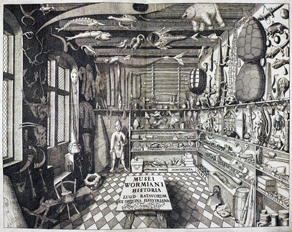
Ole Worm's cabinet of curiosities

Cabinet of Curiosities

Anyone who can introduce the deluded wisdom of Count Arthur Strong in to a business meeting has got to be listened to, at least for a moment in time! Thank you Chris for a fascinating morning!

Image credit:”Musei Wormiani Historia”, the frontispiece from the Museum Wormianum depicting Ole Worm’s cabinet of curiosities, from Wikimedia Commons; Nannini Cruser Goggles from The Retronaut.

Posted in case studies, project news | Comments Off on A time traveller visits

The end of civilization?

A fascinating report on RunCoCo’s Oxford meeting on 5 May, has been written by Chris Batt OBE, one of the speakers: ChB:PhD.

How do you feel about crowdsourcing, co-creation and community engagement? Does the thought of involving outside folks in collection building and knowledge creation sound to you like the end of civilization as we know it or a liberating opportunity to build relationships that give new meaning to your service mission?
Chris Batt opens with this challenge

Chris spoke at the RunCoCo meeting on the subjects of his 2009 report Digitisation, Curation and Two-Way Engagement, and his blog post reflects on this but also the discussions and feelings expressed on the day by the delegates, most of whom were from the University of Oxford.

Last week’s RunCoCo event was one of a number of conferences recently attended where museum, library and archive professionals have reported on engagement projects and not a few, while, relishing the chance to work with communities, reflected on what might be the longer term implications for their institutions and their own professional roles. That was the undercurrent I sensed at RunCoCo. Sustaining engagement long-term will require shifts in how things are done, empowering citizens through a sense of ownership…
Chris Batt

We have our work cut out, time to roll up RunCoCo’s sleeves!

Posted in events, project news | Comments Off on The end of civilization?

Oxford community collections meeting

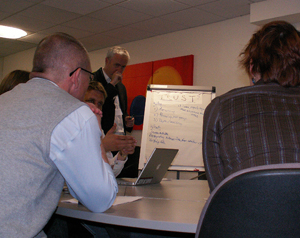
On Weds 5 May 2010 RunCoCo hosted a meeting of Oxford-based community collections and similar projects, as well as other experts with an interest in community contributed digitisation, crowdsourcing and community enriching of an existing collection with tags or comments. In this post you may read about the meeting’s purpose, agendaspeakers and delegates. In an additional page of this blog you can now read our recorder’s write-up of the day. In future we will also publish photos as well as audio/video from the discussions. Watch this space!

Delegates discuss trust/authenticity issues

Delegates discuss trust/authenticity issues

Purpose of the meeting

This meeting was free of charge and open to anyone based in the University of Oxford or from the education/public sector near Oxford. It was intended for anyone interested in community collections (like The Great War Archive) or working to harness a community to enrich an existing collection with tags or comments (like Galaxy Zoo). The meeting had a number of purposes:

  • This was a chance for managers and others from community collection projects in and around Oxford to share best practice and exchange knowledge;
  • This was an opportunity for Oxford projects with some shared interests to meet face-to-face. The OUCS project, RunCoCo, has launched an online ‘community of interest’ for those involved in community collection or working to harness a community to enrich an existing collection with tags or comments. In the past OUCS has done this successfully for other subjects (like teaching First World War literature). However, these ventures have a better chance of working well when participants have met in person;
  • RunCoCo also disseminated some of the processes, open-source software and results of The Great War Archive, a pilot community collection project based at OUCS and the English Faculty, which ran for 3 months in 2008. RunCoCo captured the results of any discussions from the day and will now use this to ensure our resources are correctly focussed on what projects need to run this kind of initiative;
  • RunCoCo highlighted three training workshops we will hold during 2010 to disseminate resources and software for community collection projects. We hope to encourage other community projects to present at one or more of these workshops, and to encourage newer projects like those funded under the recent JISC calls for developing community content (Strand I and Strand II) to attend. The workshops will be free of charge and open to anyone from the education/public sector. The first is on 26 May at OUCS.

Agenda

  • Exercise 1: Introductions and Challenges
  • Case-studies Galaxy Zoo and The Great War Archive
  • Overview of crowdsourcing
  • Chris Batt OBE: Digitisation, curation and two-way engagement, and the future
  • Exercise 2: optional: Recording elevator pitches
  • Exercise 3: Community collection priorities
  • Demonstration: CoCoCo, open-source collection software
  • Exercise 4: Breakout groups discussion

The meeting was held 10.30am – 4.30pm, at OUCS, 13 Banbury Road, Oxford OX26NN.

Speakers

  • Alun EdwardsAlun is the manager of the RunCoCo project. He was the host for the meeting, and spoke about the work of The Great War Archive community collection, as well as crowdsourciing and academia. Alun also demonstrated the community contributed collection software, CoCoCo, which RunCoCo intend to release as open source at the end of May.
    Dr Chris LintottChris is a post-doctoral research in the Department of Physics at the University of Oxford and a junior research fellow at Somerville College. He has become involved in what is known as ‘popular science’, most familiarly as co-presenter on the BBC’s Sky at Night programme alongside Sir Patrick Moore, and as co-author of Bang!, with Sir Patrick and Dr Brian May. At this meeting Chris spoke about Galaxy Zoo, (he is the principal investigator of that project).
  • Chris Batt OBEChris was the former Chief Executive of the MLA (Museums, Libraries and Archives Council ). Since 2007, as a director of Chris Batt Consulting Ltd, he has undertaken research projects for JISC on the scoping of audience engagement in online service design, the creation of a wiki-based guide to all aspects of public content digitisation and a study assessing the value of university engagement with the public in the creation and curation of digital resources. At this meeting Chris spoke about his report from 2009, Digitisation, Curation and Two-Way Engagement.

Delegates

We were very pleased to welcome Chris Batt OBE (Chris Batt Consulting) and Alastair Dunning (JISC) as well as fifteen other delegates representing the following parts of the University of Oxford: Faculty of English; Computing Services (OUCS); Nuffield Department of Obstetrics and Gynaecology; Continuing Education; Office of the Director of IT (ODIT); Physics; Pitt Rivers Museum; Oxford Internet Institute; Refugees Studies Centre, Oxford Dept of International Development; Bodleian Library; and Modern and Medieval Languages – Russian.

Posted in events, project news | 1 Comment

JISC announces Community Content Call: Strand II winners

Congratulations to the five projects that will be funded under the JISC Grant 13/09: BCE, e-Content & Digitisation call for Community Content, Strand II (developing community content aims to build new digital collections, or transform existing collections through genuine co-creation with specific external communities):

  • OurWikiBooks, (Conditional Award) University of Manchester (Alexandria Walker): This project will undertake co-development, with teachers and GCSE and A-level students, of a new digital collection of key concerns and knowledge in computing education. In the process, the project will build a community that collaboratively creates digital collections of imaginative educational materials for use in learning and teaching computing, with this content being made available to the computing education community in the UK and worldwide.
  • My Leicestershire, University of Leicester (Ben Wynne): This project will create a base digital archive comprised of historical texts from the University of Leicester Library’s Special Collections complemented by video recordings from MACE, oral history recordings from EMOHA and private collections of historical photographs of ‘ghost signs’, buildings, bridges and other architecturally significant sites from across the county.
  • Media and Memory in Wales 1950-2000, (Conditional Award) University of Aberyswyth (Dr. Iwan Rhys Morus): This project will collect and archive oral testimony relating to the age of television in Wales. It will solicit memories of significant televisual moments in politics and culture. By focussing on four distinct geographical and linguistic communities, it will seek to provide a spectrum of memories that represent a national collective memory of television in Wales.
  • Welsh Voices of the Great War Online, University of Cardiff (Gethin Matthews): This project will work with the families of those in Wales who fought, or otherwise served, in the First World War in order to collect and make available online the range of artefacts that are held in private hands. The results will be presented via the People’s Collection website, a Welsh Assembly Government funded project.
  • Community Cafe Projects, (Conditional Award) University of Southampton (Alison Dickens): The project will address the scarcity of up to date, online resources for community languages. The aim of the project is to co-create a community collection of online language and cultural materials which will significantly enhance existing materials to support community languages.
Posted in digitisation & ugc | 1 Comment

Delicious links

delicious

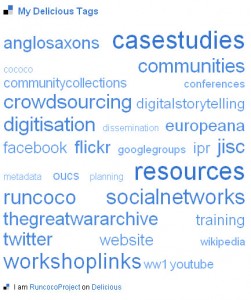
RunCoCo is leading a number of workshops and making presentations in May. We’re circulating the links to resources mentioned during our talk using Delicious – tagging this material RuncocoProject/workshoplinks.

Posted in events, project news | Comments Off on Delicious links

Free Community Collections Workshop: Oxford

Registration is now open for the free RunCoCo workshop: How to Run a Community Collection Online on Weds 26 May 2010 in Oxford.

This training workshop is free of charge and open to anyone from the education/public sector who is interested in community collections (like The Great War Archive) or working to harness a community to enrich an existing collection with tags or comments (like Galaxy Zoo). The workshop will:

The meeting will be held 10.00am – 5.00pm, at OUCS, 13 Banbury Road, Oxford OX26NN. Lunch and other refreshments will be provided free-of-charge.

See the OUCS Travel page for maps and further information about visiting OUCS.

Workshops are free of charge and open to anyone from the education/public sector.

Places are limited, so please register your interest by completing our form on SurveyMonkey by 1200 on 14 May 2010. Confirmation of your place will be sent ASAP.

Posted in events, project news | Comments Off on Free Community Collections Workshop: Oxford

Make: Open

RunCoCo present about Crowding together Tue 11 May12:30-13:30, OUCS

RunCoCo present about "Crowding together" Tue 11 May12:30-13:30, OUCS

On Tuesday 11 May 12:30-13:30, at OUCS, RunCoCo will present about the creative uses of technology in research and teaching to Make: Open i.e. make a crowd work for your project.

Posted in events, project news | Comments Off on Make: Open

Update Apr-May 2010

In April we have…

  • interviewed some extremely skilled candidates for the RunCoCo project officer, and have successfully appointed someone, just waiting for that person to start

Training workshops

We have been planning for 2 free workshops:

Beyond Borders conference: The place of research institutions in open education

Dissemination

Community Contributed Collection software (CoCoCo)

  • development continues of the open-source CoCoCo software which facilitates the online collection of digital objects

Exemplar community collection

Worked with the exemplar project – Woruldhord mainly on metadata for their collecting of learning objects.

RunCoCo present about Crowding together Tue 11 May12:30-13:30, OUCS

RunCoCo present about "Crowding together" Tue 11 May12:30-13:30, OUCS

Next month we will…

  • complete development of the CoCoCo software
  • undertake the induction of the new project officer
  • prepare and deliver a RunCoCo course Make: Open (Crowding together) on Tuesday 11 May 12:30-13:30, at OUCS
  • participate in the first meeting of a new OUCS SIG (special interest group) to look at how IT can assist with impact, widening participation and outreach activities of the university
  • meet Chris Wild, from The Retroscope, one day our calendars must coincide!
  • continue working with the exemplar project (with Dr Stuart Lee)
  • host and run the first 2 RunCoCo training workshops
  • collaborate in the writing of a bid to Europeana
  • start to write training documentation for dissemination at the free training workshops to be held in Oxford and around the UK.

We use this blog to let you know about our training documentation and workshops, and any other news.

Posted in project news, updates | Comments Off on Update Apr-May 2010

JISC 2010 conference

RunCoCo is presenting at the JISC 2010 conference in London (12-13 April) as part of the Community collections and the power of the crowd panel. Even if you are unable to attend you can follow the conference online and on Twitter #jisc10.

Posted in project news | Comments Off on JISC 2010 conference