GLAM-WIKI: brief report from the conference

Galleries, Libraries, Archives, Museums & Wikimedia: Finding the common ground

The GLAM-WIKI conference took place in London at the end of November 2010. Material from the event (slides, audio, pictures) is being made available via the event page http://glamwiki.org/

The conference brought together people from two communities (and then some): those in the GLAM sector (from museums, libraries, archives, and museums) and those involved with Wikimedia, for example Wikipedia editors and people working for or with the Wikimedia Foundation. The idea was to explore how the two communities can work together, for mutual benefit.

In these times of economic austerity, Galleries, Libraries and Museums have to look for new and imaginative ways to maximise the impact of their collections and knowledge. (…)  working with the Wikimedia websites would offer Galleries, Libraries and Museums a new window on a potential global audience of over 375,000,000 people worldwide. (from http://glamwiki.org/)

From the programme
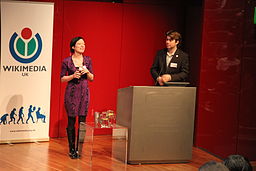
Sue Gardner (executive director, Wikimedia Foundation) and Liam Wyatt (Wikipedian in Residence at British Museum) at GLAM-WIKI conference, Nov 2010

Sue Gardner (executive director, Wikimedia Foundation) and Liam Wyatt (Wikipedian in Residence at British Museum)

The conference featured keynote presentations, presentations covering different aspects of GLAM-WIKI work, and two ‘un-conference’ sessions where the audience decided the content. Among the speakers were Jimmy Wales (Wikipedia founder),  Sue Gardner (Executive Director of the Wikimedia Foundation), Cory Doctorow (science fiction author, activist, journalist and blogger),  Dr. Kenneth Crews (Director, Copyright Advisory Office of Columbia University, New York);  Jill Cousins (Director of Europeana),  Tom Morgan (Head of Rights and Reproductions, National Portrait Library); and many more.

Themes that were discussed included examples of how material can be made freely available online and still generate revenue, or even increase the commercial potential, something which may be particularly interesting for institutions looking for new revenue streams. Copy-right issues also featured in many talks, not least in the key-note by Dr. Kenneth Crews (Director, Copyright Advisory Office of Columbia University, New York) and the panel discussion following that.

A number of presentations described collaborative projects of different kinds, such as Partnership with the City of Toulouse (Jean-Frédéric Berthelot and Bastien Guerry, Wikimedia France), Swedish GLAMs and Wikipedia (Kajsa Hartig, Nordiska Museet), Integrating volunteers and Experts – examples from the Portable Antiquities Scheme by Daniel Pett (slides), and Opening up The British Library’s metadata by Neil Wilson (slides).

There were also presentations about Wikipedia and work that is going on within the foundation. More details and links to presentations slides can be found on the conference website  http://glamwiki.org/.

As a result of the ‘un-conference’ section of the programme, a new wiki page has been set up: Potential GLAM collaborations in the UK. It can be used by GLAM and Wikimedia members to identify future GLAM-WIKI collaboration opportunities, including but not exclusively new ‘Wikipedian in Residence’ projects.

Wikipedian in Residence

The GLAM-WIKI event took place at the British Museum, a natural venue after the  ‘Wikipedian in Residence’ project this summer. For the project, the Wikipedia editor Liam Wyatt spent five weeks at the museum, working with their staff and Wikimedia contributors to foster a relationship between the two worlds and explore how the collaboration could benefit them both. The project resulted in the creation and improvement of a number of Wikipedia articles about objects in the British Museum and related topics. A further effect of the project has been to awake interest in similar collaborations elsewhere.

More information about the ‘Wikipedian in residence’ project:

See also Potential GLAM collaborations in the UK wiki page.

Finally: So what IS Wikimedia and does it have anything to do with the online encyclopedia?

The Wikimedia Foundation, Inc. is a non-profit charitable organisation that operates a number of ‘wiki’ projects. The most well-known is Wikipedia – the online encyclopedia.

The Wikimedia Foundation’s stated goal is to develop and maintain open content, wiki-based projects and to provide the full contents of those projects to the public free of charge. (from the Wikipedia article)

Image credits: By Akoopal (Own work) [GFDL or CC-BY-SA-3.0-2.5-2.0-1.0], via Wikimedia Commons

Posted in events (external) | 1 Comment

Workshop: Maximising Online Resource Effectiveness

Over the last year, the JISC Strategic Content Alliance (SCA) and Netskills have been running a workshop on ‘Maximising Online Resource Effectiveness’ in different venues across the country. Content from the day (slides and pictures) can now be found on the accompanying SCAMORE website together with some news, interviews with participants, and archived tweets from the training days.

The two-day event, with the sub-title “How to use the latest techniques to improve the quality of your web presence” deals with topics such as:

  • How to improve search and discovery of online resources
  • An exploration of technologies such as HTML5 and CSS3
  • Emerging search engine enhancements and techniques
  • The importance of the semantic web and semantic mark-up
  • Accessibility issues and access management
  • Content integrity and reaching the right audience
  • Metadata and its significance, particularly RDFa
  • The use of social media including cloud and blog services

More information about the workshop is available from Netskills.

Posted in events (external) | Comments Off on Workshop: Maximising Online Resource Effectiveness

Conference clash this week

This weeks sees two interesting conferences clashing in London, if ‘clashing’ is the term to use. The events will, partially, be taking place at the same time in different venues, but there is also a collaboration between them to allow interested parties to enjoy parts of both.

The two events are GLAM-WIKI:UK –  Galleries, Libraries, Archives, Museums & Wikimedia: Finding the common ground and the UK Museums on the Web Conference UKMW10 – Doing more with less: Rising to the digital challenge in difficult times. The events have a common theme: both take the current difficult time as a starting point and look at what the cultural sector, and museums in particular, can do.

In these times of economic austerity, Galleries, Libraries and Museums have to look for new and imaginative ways to maximise the impact of their collections and knowledge. (GLAM-WIKI webpage )

Confronting head-on our immediate digital challenge, [UKMW10] will explore the ways digital heritage can respond to these difficult times. (UKMW10 webpage)

GLAM-WIKI is a two day (and one evening) event being held in the British Museum on 26-27 November. The program features a series of presentations on different aspects of collaboration between the cultural sector and Wikimedia (details on the GLAM-WIKI page). The evening session on the Friday is a Wikimedia UK – Museum Computer Group joint event: ‘The free-conomy & the cultural sector’, featuring a key-note by Dr. Kenneth Crews followed by panel responses and an audience Q&A.

UKMW10 (26 November) proposes to look at what the recent policy and funding announcements will mean and discuss what the community can do, high-lighting four ways to approach the challenges:.

the conference will highlight four clear and distinct ways in which, together, we can engage with the challenges ahead: through smart aggregations of our digital collections; open-source tools and methods for designing our systems; creative approaches to collaborative working; and new and imaginative models for funding our work. (UKMW10 webpage)

More information about the events can be found on the respective webpages: UKMW10 and GLAM-WIKI. The events are already being discussed on Twitter – look for the hashtags #ukmw10 and #GLAMWIKI.

Posted in events (external) | Comments Off on Conference clash this week

Curiouser & Curiouser

Spring may feel far away on a bleak November day but it doesn’t mean we cannot look ahead and plan for things to come. Curiouser & Curiouser : Challenging Convention and Celebrating the Unusual in Museums and Heritage is a three-day PhD symposium to be held in Leicester from 28-30 March 2011. The call for papers describes the event as  “challenging conventional perceptions of cultural institutions and the roles which they play in contemporary society.”

Definitions of what is acceptable within museums and collections are changing, catalysed by the blurring of boundaries once enforced by such factors as national identity, ethnicity, socio-economic position and public and personal ideologies. Is what was once considered bizarre or strange becoming more mainstream? What exactly is meant by ‘curious’ or ‘eccentric’, and need such words have pejorative connotations? from the Call for papers

The event is organised by the School of Museum Studies at the University of Leicester. The programme will feature both presentations and workshops and contributions are invited from the areas of  museum studies, cultural studies and allied subjects. Particularly welcome are submissions which propose to use innovative and experimental presentation strategies.

More information about the event and the call for papers is available in The Attic – a blog for the School of Museum Studies’ research students, University of Leicester, UK. To register, fill out the forms available from http://www2.le.ac.uk/projects/curiouser/delegates

Posted in events (external) | 1 Comment

JISC: Digital Content Partnerships

The JISC e-Content Programme currently has two funding calls: JISC Grant Funding 11/10: eContent Programme and JISC Grant Funding 16/10: Rapid Digitisation, both with submission deadline on December 10, 2010 – a deadline that is fast approaching.

The 11/10 eContent Programme call is particularly interesting from a community collection point of view. It has two strands:

  • A: Enriching via Collaboration – Using collaboration to cluster, repackage and represent existing digital content
    For example (from the Call for proposals):
    – “taking multiple existing resources and creating one single product with a more marketable theme”
    – “exposing content via new web platforms and devices, or improving the quality and relevance of an existing resource”
    – “exposing the content from a museum, society or business to HE audiences”
  • B: Developing Community Content – To develop new content and communities for educational and social purposes.
    From the Call for proposals: “JISC would now like to take forward a further phase of funding to develop its understanding of the potential of this area, broaden the types of content and collections that might be developed in this way, and to spread this learning through the university and BCE community within the UK and beyond

JISC are proposing to fund 4-5 projects for Strand A, 5-6 for Strand B, and 5-7 for Rapid Digitisation, each with a maximum of £50-£100,000 per project. The successful eContent projects will start by March 1 2011 and be completed no later than 30 September 2011. The Rapid Digitisation projects are even shorter, meant to run for up to five months between March and July 2011.

The Calls for proposals outline in more detail what is expected by the projects that will be funded and also provide information and advice on how the proposal should be structured and composed. Those planning to apply for the eContent funding are advised to look at Chris Batt’s study ‘Digitisation, Curation and Two-Way Engagement’ and also familiarise themselves with JISC’s Business and Community Engagement (BCE) Programme. It is also suggested that “contact with the RunCoCo project and the NCCPE is to be welcomed”.

To give prospective bidders more information about the calls, and to provide an opportunity for networking, JISC hosted a Digital Content Partnership  event on October 28th. The event, which was over-subscribed, saw some 120 participants gather to learn about the calls, meet prospective partners and listen to interesting talks. Notes and presentations from the event are being made available by the JISC Digitisation Programme. To facilitate current and future partnerships and collaboration, a list of participants was distributed at the event, with information about people’s project plans and/or what kind of partners they were looking for.

It is likely that the two calls will receive a large number of submissions (someone mentioned that about 100 would not be unexpected). Although it will be the case that not all good proposals will be funded within the scope of this call, it is nevertheless positive to see that there is such a great interest in the area and that so many good ideas exist. We are hoping that the future will see many of them realised, perhaps through new partnerships identified through the list of participants from the JISC event or through some other channel.

Posted in digitisation & ugc, events (external) | Comments Off on JISC: Digital Content Partnerships

BBC gallery: Welsh Voices of the Great War Online

For Armistice Day 2010, BBC Wales published a slideshow of images from the Welsh Voices of the Great War Online collection. The 26 images in the slideshow were selected from the growing collection being gathered by the Welsh Voices project.

The Welsh Voices project is funded by JISC and will be collecting memorabilia from the Great War until February 2011.

Welsh Voices of the Great War Online is a digital community heritage project established and co-ordinated by the School of History & Archaeology at Cardiff University which will run until February 2011. The project seeks to gather, catalogue and make public an undiscovered treasure trove of World War 1 artefacts and memorabilia which remain in private hands. (from the Welsh Voices website)

To learn more about the project and how to contribute, please visit the  Welsh Voices of the Great War Online website. You can also read about it in the RunCoCo blog. Gethin Matthews from the project has presented at RunCoCo workshops and you can find his presentations via the pages for the 27 July event and 3 Nov event. The BBC slideshow can be seen on the BBC Wales History website.

Posted in digitisation & ugc | Comments Off on BBC gallery: Welsh Voices of the Great War Online

AddressingHistory launch event

POD and Map of Edinburgh

POD and Map of Edinburgh

The JISC-funded AddressingHistory project is having its official launch on November 17 2010. The event will take place in the National Library of Scotland and the programme features a range of exciting talks related to Scottish history by projects that are working to make resources more widely available.

Join us for our official launch where we will be celebrating local Scottish history with a range of speakers and opportunities to network with others interested in the family, local, and Scottish history. (from the event invitation)

Places at the event are limited but those unable to attend in person can follow the event on Twitter (#AHlaunch) and via the AddressingHistory blog, which will have live postings and images from the event.  AddressingHistory will also be making information about the event available later via their blog, including video recordings of the talks.

More information about the AddressingHistory project can be found via the AddressingHistory website and blog. An introduction to the project has been published in the RunCoCo blog.

Image credit: POD and Map of Edinburg, by AddressingHistory. Available at  http://www.flickr.com/photos/addressinghistory/5168819379/in/photostream/ under Creative Commons Licence Attribution-NonCommercial-ShareAlike 2.0 Generic.

National Library of Scotland Board Room

Posted in events (external) | Comments Off on AddressingHistory launch event

RunCoCo workshop on sustainability

The fourth RunCoCo workshop took place in Leeds on November 3rd, 2010. A group of 30 people gathered to learn about, discuss, and share experiences of online community collection work and sustainability.

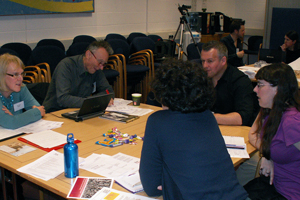
Delegates discuss sustainability issues

Delegates discuss sustainability issues

Material from the day is being published on the RunCoCo website. Learn more about the day through the tweets (@runcoco) and through summaries of the event published in other blogs, for example by Alison Cullingford and Hope Wolf (Strandlines).

V. inspiring event – I have masses of ideas to take back + think about.
Alison Cullingford (PaxCat)

The programme included a series of presentations on different aspects of sustainability, and an interactive session led by Sarah Fahmy (Strategic Content Alliance) and Alastair Dunning (Programme Manager, JISC). Four short project introductions were also offered, giving participants a chance to hear about ongoing and planned projects in the area of online community collection.

Enjoyed hearing what other organisations are doing + how they are approaching their projects. Interesting points to consider. Rachel Tapp (Our Stories)

Speakers and talks

The first speaker of the day was Beccy Shipman (Project Manager for LIFE-SHARE), who talked about collaborative working and how to make it last. She discussed the different stages of collaboration and illustrated them with examples from the LIFE-SHARE project and the White Rose libraries’ collaboration in the area of digitisation services and expertise. She also offered useful advice on what to look for when seeking a collaboration partner, suggesting looking for someone who is:

  • Committed to collaboration
  • Trustworthy
  • Willing to trust
  • Good communicator
  • Supported by institution
  • Open minded and willing to experiment

(More information about Beccy’s talk, including copies of the presentation slides,  can be found via the Events page)

Kate Lindsay, Project Manager for the Great War Archive (GWA) showed how GWA used Flickr after the end of the project to allow people to continue to share their WW1 images. She demonstrated how there had been unexpected benefits of doing this: the community had grown and people were not only using the Flickr group to publish images but also to communicate and share information – to add comments, ask questions and discuss the content of the pictures. Based on her experience of doing this work for the GWA and her knowledge of later developments in the area of Flickr, social networks, and Web 2.0, Kate offered advice, suggestions, and tips for projects wanting to do something similar. (More information about Kate’s talk, including copies of the presentation slides,  can be found via the Events page)

Leigh Garrett from Visual Arts Data Service talked about the work of the Look here! project in examining issues of sustainability of digital collections. He suggested that projects and services need to look for a combination of methods to sustain and grow collections such as including diverse revenue streams, provide a range of services, embedding, licensing, collaboration, vision, creativity, and persistence. In reply to his own question ‘Where do we go?’, he listed four areas: ‘intrinsic and extrinsic collaboration’ (sharing resources, costs, and expertise), ‘discoverability and critical mass’, ‘measuring value and impact’, and ‘learning from each other’. (More information about Leigh’s talk, including copies of the presentation slides, can be found via the Events page)

Lisa Greenhalgh from Our Stories, based at West Yorkshire Archive Service, presented on ‘Building digital preservation into community collecting’. After showing some thought-provoking examples of what can happen to a community collection if digital preservation is not made part of the project, she offered a range of suggestions, recommendations, and advice on how to ensure digital objects can be preserved. (More information about Lisa’s talk can be found via the Events page)

Interactive session

The session between lunch and afternoon coffee was run by Sarah Fahmy and Alastair Dunning. Sarah opened by giving a presentation on ‘Sustaining Digital Resources’ and Alastair offered some case studies to illustrate certain points. The workshop participants then discussed in groups how their projects could or had engaged with the suggested success factors:

  • Empowering leadership
  • Creating a strong value proposition
  • Creatively managing costs
  • Cultivate diverse sources of revenue
  • Establish realistic goals

(More information about the session, including copies of the presentation slides, can be found via the Events page)

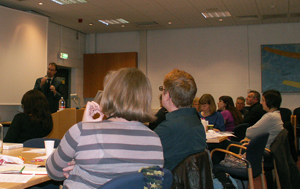
Alastair Dunning and Sarah Fahmy introduce the interactive workshop session

Alastair Dunning and Sarah Fahmy introduce the interactive workshop session

Project introductions

In addition to the talks and interactive session, the programme included four short ‘project introductions’ by Stuart MacDonald (AddressingHistory), Alison Cullingford (PaxCat), Nicky Ferguson (Visualising China), and Gethin Matthews (Welsh Voices of the Great War Online). These were included as an opportunity for interested parties to introduce a project or project idea to the participants in order to stimulate and facilitate sharing of ideas, experiences, etc during the day. (More information about the short talks, including copies of the presentation slides, can be found via the Events page)

Interesting range of speakers – liked the short project introductions.

Networking opportunities

Participants were encouraged to use the event to share ideas and experiences and a lot of networking was going on during the coffee and lunch breaks.

Super networking opportunity – made great links. Alison Cullingford (PaxCat)

Really good to meet other people & hear about their projects & think about how to do stuff together. Jen Fox

It was encouraging to hear so many people say they had made useful contacts or even met potential project partners during the day. It will be interesting to see what collaboration may come out of this, hopefully resulting in new and sustainable community collections.

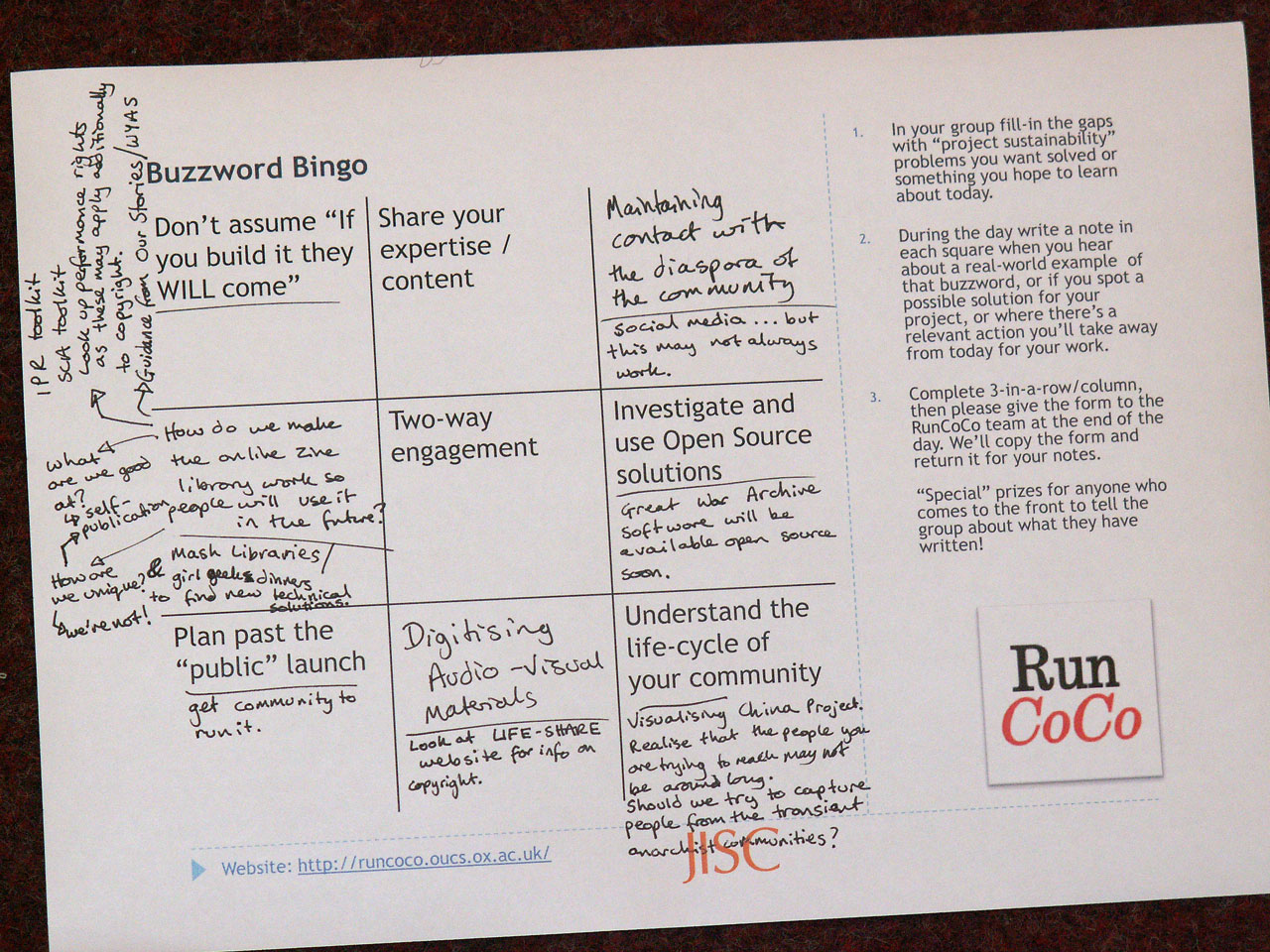
The RunCoCo team asked delegates to fill-in bingo cards to record their experiences of the day

Click on this photo to see the sort of experiences recorded on the day by delegates who were asked by the RunCoCo team to fill-in bingo cards. Later we will report back on all this excellent feedback.

Thanks to everyone

RunCoCo would like to thank all participants and speakers for participating in the event and contributing to its successful completion. We are also extremely grateful to LIFE-SHARE for helping with the venue and the practical  arrangements before, during, and after the event. Last, but not least, thanks to Jodie and Matt for recording the sessions to allow us to make material available to those who weren’t fortunate enough to be able to attend the event on the day.

Posted in events, project news | 2 Comments

Sustainability for Digital Content

We are very pleased to welcome Sarah Fahmy (Strategic Content Alliance) and Alastair Dunning (JISC) to the RunCoCo workshop in Leeds on November 3rd 2010. Sarah and Alastair will be leading an interactive session on Sustainability for Digital Content. This is how they describe their session:

Sustainability for Digital Content

Sustainability is a loaded word. From social and economic to environmental, sustainability has continued to mean vastly different things to different people. In the context of this presentation, we consider the meaning of sustainability within the context of generating or gaining access to the resources-financial or otherwise-needed to protect and increase the value of the digital content or service for those who use it.

Within this, a key question that we would seek to address would be: ‘What means can project leaders employ to support the resources they have developed, beyond grant funding?’

In attempting to answer this question, the presentation shall deliver an overview of ground-breaking research in these areas and how some of the core findings and recommendations can be built into the digital strategy of public sector organisations of all sizes to ensure sustainable services long into the future.

* New or innovative JISC work covered in the presentation*

As organisational budgets tighten and economic uncertainty threatens, many digital projects struggle to develop coping strategies when the funding to support core operations and/or essential development is not forthcoming. Groundbreaking research (as highlighted in this presentation) being undertaken by Ithaka S + R on behalf of the StrategicContent Alliance:

  • Gives project leaders ‘real-world’, international examples/ case studies- how support has been delivered to the digital services, beyond grant funding.
  • Highlights ‘5 steps to Sustainability’- defines ways in which the ‘most successful’ sustainable projects have undertaken to address this issue
  • Gives examples of how project leaders can manage the inherent tension between providing free access, and generating the revenue needed to support ongoing operations and work this into their organisation’s digital strategy

Brief biographical details

Sarah Fahmy works within the Innovation Group at JISC and manages the Strategic Content Alliance initiative. She oversees and supports a variety of projects and studies and participates in various
collaborative activities, the aim of which is to work on behalf of the public sector holistically to reduce the technical, political and administrative barriers that impede access to digital content. Sarah previously worked on a Becta-funded programme to collectively license a range of commercial resources enabling schools across the UK to benefit from large discounts through joint purchase. Prior to that, she worked at the Tate Gallery and HarperCollins publishers in the licensing of collections and content.

Alastair Dunning is  Programme Manager, Digitisation (JISC). From his staff page:

“As a programme manager I am responsible for projects funded under the JISC’s e-Content programme. This strand of work deals with the creation and delivery of digital resources, such as the British Library’s Archival Sound Recordings3 or the East London Theatre Archive4 for use in research, teaching and learning.

The role of programme manager entails a good few responsibilities, but mainly involves overseeing the direction of JISC programmes as a whole, assisting and advising projects during their lifetime, ensuring that the projects are completed on time and within cost, and managing the overall budget for the programme. More broadly, my role also involves providing strategic direction to the JISC’s strategy for digital content in Higher Education.”  (http://www.jisc.ac.uk/contactus/staff/alastairdunning.aspx )

Posted in digitisation & ugc, events, project news | 1 Comment

Building digital preservation into community collecting

At the RunCoCo workshop in Leeds, 3rd Nov, we will have the pleasure of a presentation by Lisa Greenhalgh from OurStories, based at West Yorkshire Archive Service .

Our Stories - project logo

Our Stories - project logo

The Our Stories project aims to deliver a self-sustaining support network, training and an accreditation scheme for community archive projects.

This will empower community groups to play an active part in the conservation of their heritage by providing comprehensive archival training, promoting new projects and improving access to the WYAS collections. Heritage Lottery Fund news item

OurStories is based at West Yorkshire Archive Service and recordings and memories collected throughout the three-year project will be added to the Nowthen website.

For the RunCoCo workshop, the project is giving a presentation with the title:

Pass it on: ideas for building digital preservation into community collecting

digitisation should not be embarked upon without giving communities clear instructions on looking after digital records from the very start … this is part of what they get out of their collaboration! (Lisa Greenhalgh, OurStories)

Posted in events, project news | Comments Off on Building digital preservation into community collecting